
From Eden to Eternity: A Biblical Journey Part 6
Genesis 11: The Tower of Babel and the Scattering
From Rebellion to Redemption Part 6
Blog Series: From Eden to Eternity
Introduction: When Unity Becomes Idolatry
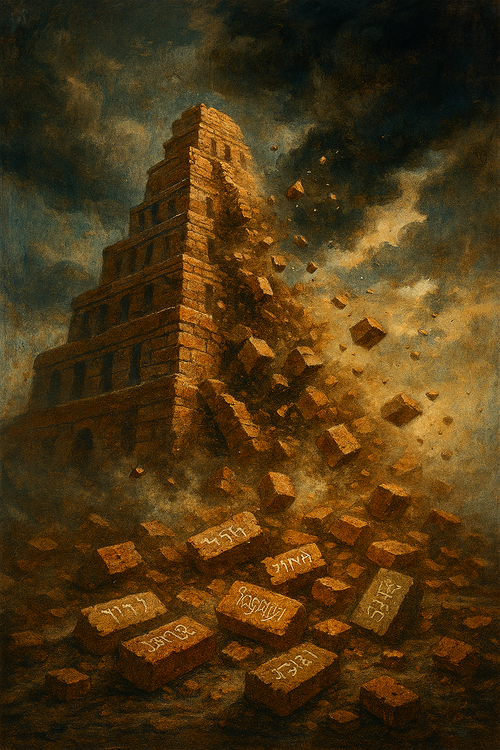
The floodwaters have receded. The rainbow still arcs across the sky. Humanity has a fresh start, yet within two chapters, the old pattern returns. Genesis 11:1–9 tells the story of a people united not in worship, but in pride. “Come, let us build ourselves a city and a tower with its top in the heavens, and let us make a name for ourselves…” (English Standard Version Bible, v. 4).
What begins as architectural ambition ends in divine intervention. The Tower of Babel is not just a failed construction project; it’s a mirror of the human heart, and a warning for the generation Jesus describes in Matthew 24.
A Unified Rebellion
The text is strikingly concise, yet loaded with irony:
- One language, one speech (v. 1) — a gift of post-flood harmony.
- “Let us make bricks… let us build” (vv. 3–4) — human initiative replacing divine command.
- “Lest we be scattered” (v. 4) — direct defiance of God’s earlier mandate: “Be fruitful and multiply and fill the earth” (Gen. 9:1).
The City That Reached for Heaven
Ancient ziggurats, like the Etemenanki in Babylon, were real structures with religious and political purpose. Their stairways symbolized ascent to the gods. Archaeologists have uncovered baked bricks and bitumen mortar matching Genesis 11:3. But the biblical account subverts the pagan narrative:
- In Mesopotamian myth, humans serve the gods by building temples.
- In Genesis, humans build for themselves, and God comes down not to be served, but to judge.
The tower becomes a monument to self-salvation; a theme that echoes through history and into the apocalyptic deception of the last days (2 Thess 2:4; Rev 13).
“Come, Let Us Go Down” – The Divine Council
Genesis 11:7 is startling: “Come, let us go down and there confuse their language...” The plural echoes Genesis 1:26 (“Let us make man…”). Early Jewish and Christian interpreters saw Trinitarian hints here, but even without that, the phrase reveals active divine engagement. God is not distant. He inspects (v. 5), He speaks, He acts.
Cyril of Jerusalem wrote: “As in the days of Noah, God walked among men. At Babel, He walked among their bricks—and found no faith” (Cyril of Jerusalem, ca. 350/2004, Catechetical Lecture 15, para. 23-25, para. 23–25, as paraphrased).
The Scattering: Judgment with Purpose
The confusion of languages is not petty retaliation. It’s redemptive restraint.
- It enforces the cultural mandate (fill the earth).
- It curbs collective tyranny, one language, one rebellious will, one global empire.
- It prepares the stage for Abraham; a man from one scattered family, called to bless all families (Gen 12:3).
Matthew 24 Connection: “As in the Days of Noah… and Babel”
Jesus doesn’t mention Babel directly, but the parallels are striking:
- Global ambition: The Antichrist will unify nations under a false name (Rev 13:7).
- Signs in the heavens: The tower reached for the sky; false christs will perform “great signs” (Matt 24:24).
- Sudden judgment: Just as the builders awoke to incomprehension, so the Son of Man comes “like a thief” (Matt 24:43).
The Church Fathers on Babel
- Irenaeus interpreted the tower as a monument of pride and the scattering of languages as divine mercy, preventing unified evil from overwhelming humanity; a providential division to preserve the possibility of redemption (Against Heresies 3.23.3–4; cf. Irenaeus, ca. 180/1989, Book 3, chap. 23).
- Chrysostom taught that a single language fostered arrogance and rebellion, while the multiplication of tongues humbled humanity, teaching dependence on God (Homilies on Genesis 29.10–12; Chrysostom, ca. 388/1986, Homily 29 on Genesis).
- Gregory of Nyssa viewed the tower allegorically: human ambition built a failed ladder to heaven, but Christ, descending in the Incarnation and ascending on the Cross, becomes the true ladder that raises humanity to God (Life of Moses 2.12–15; On the Making of Man 16; Gregory of Nyssa, ca. 380/1978, Life of Moses, Book 2, paras. 12–15).
Reflection and Response
- How does the desire to “make a name” show up in our culture today?
- In what ways do we resist God’s command to “fill the earth” (geographically, culturally, spiritually)?
- How does the scattering at Babel prepare the way for the ingathering of the nations in Christ?
- What does it mean to live “scattered but sent” in a world rushing toward false unity?
Closing Thought
Babel is not the end of the story; it’s the pivot. From the ruins of human glory rises a single line: “Now the Lord said to Abram…” (Gen 12:1). The tower crumbles. The languages multiply. But God is already writing the next chapter; one man, one promise, one nation, one Savior.
As Matthew 24 warns of a world uniting in deception, remember: true unity is not built with bricks, but with faith. The next time you hear a call to “make a name,” ask whose name will last.
References
Augustine. (2008). The city of God (M. Dods, Trans.). In P. Schaff (Ed.), Nicene and Post-Nicene Fathers, First Series: Vol. 2 (Original work published ca. 426). Hendrickson Publishers. (Reprint of 1887 edition).
Calvin, J. (1847). Commentaries on the first book of Moses, called Genesis (Vol. 1) (J. King, Trans.). Calvin Translation Society. (Original work published 1554).
Chrysostom, J. (1986). Homilies on Genesis 18–45 (R. C. Hill, Trans.). In T. P. Halton (Ed.), The Fathers of the Church: Vol. 82 (pp. 1–234). Catholic University of America Press. (Original work preached ca. 388).
Cyril of Jerusalem. (2004). Catechetical lectures (E. H. Gifford, Trans.). In P. Schaff & H. Wace (Eds.), Nicene and Post-Nicene Fathers, Second Series: Vol. 7. Cyril of Jerusalem, Gregory Nazianzen (pp. 1–157). Christian Literature Publishing Co. (Original work published ca. 350) https://www.newadvent.org/fathers/310115.htm
Gregory of Nyssa. (1978). The life of Moses (A. J. Malherbe & E. Ferguson, Trans.). Paulist Press. (Original work composed ca. 380).
Irenaeus. (1989). Against heresies (A. Roberts & J. Donaldson, Trans.). In A. Roberts, J. Donaldson, & A. C. Coxe (Eds.), Ante-Nicene Fathers: Vol. 1 (pp. 315–567). Christian Literature Publishing Co. (Original work composed ca. 180) https://www.newadvent.org/fathers/0103.htm
Origen. (1996). Homilies on Luke (J. T. Lienhard, Trans.). In T. P. Halton (Ed.), The Fathers of the Church: Vol. 94 (pp. 1–132). Catholic University of America Press. (Original work published ca. 233–244).
Recent
From Eden to Eternity: A Biblical Journey Part 7
November 26th, 2025
It is just rain
November 25th, 2025
The Light Seeker’s Journey: A Narrative Allegory Inspired by Psalm 27 (English Standard Version Bible)
November 9th, 2025
From Eden to Eternity: A Biblical Journey Part 6
November 2nd, 2025
Jeremiah Chapter 35 - What I learned
October 23rd, 2025
Archive
2025
September
October
No Comments